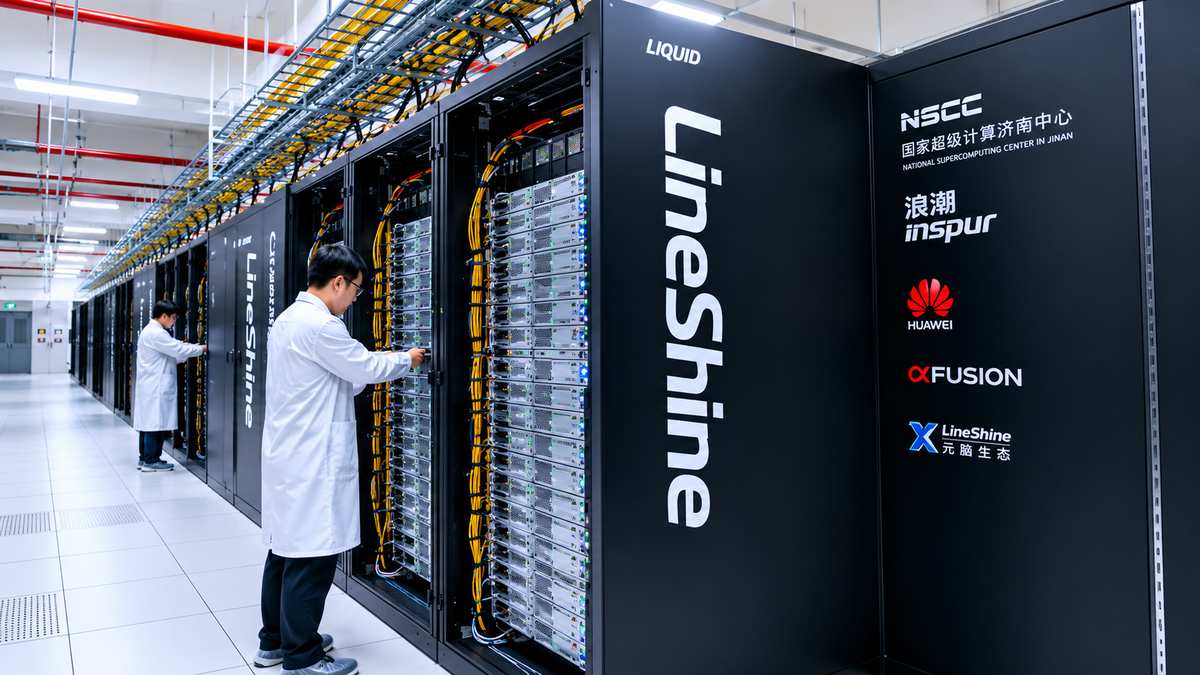
China has developed a new supercomputer called LineShine that works without graphics processing units, or GPUs. This is unusual because most of the world’s fastest supercomputers depend heavily on GPUs for artificial intelligence, scientific research, weather forecasting, and other complex computing tasks. The project is important because China is trying to reduce its dependence on foreign technology, especially high-end chips from Nvidia.
As the global AI race becomes more competitive, access to advanced GPUs has become one of the most important parts of building powerful AI systems. China’s LineShine shows that it may be possible to create a high-performance system using a different approach. Instead of relying on GPUs, LineShine uses a huge number of CPU cores. This gives the machine strong computing power, although it also creates some challenges in efficiency and AI performance.
What Is LineShine?
LineShine is a CPU-only supercomputer designed to deliver high computing performance without using GPUs. It can reach up to 1.54 exaflops of performance, which means it can complete one quintillion calculations per second. The system uses LX2 processors based on the Armv9 architecture, and each LX2 processor includes 304 CPU cores. CPUs, or central processing units, are the main processors used in computers.
They handle general tasks, manage systems, and process different types of work. GPUs were originally designed for graphics and gaming, but they are now widely used for AI because they can handle many similar calculations at the same time. Most modern supercomputers use both CPUs and GPUs, but LineShine uses only CPUs.
Also Read: WeedHack: The Dangerous Malware Hiding Behind Minecraft Mods
How Does It Work Without GPUs?
LineShine replaces GPUs with a very large number of CPU cores. The supercomputer has 20,480 compute nodes, and each node contains two LX2 processors. Since every processor has 304 CPU cores, each node has 608 CPU cores.
Across all 20,480 nodes, LineShine has a total of 2,451,840 CPU cores. This huge number of cores allows the system to divide large tasks into smaller parts and process them at the same time. Instead of using GPUs to handle parallel computing, LineShine uses millions of CPU cores working together.
Special Features Inside Each Core
LineShine does not depend only on the number of CPU cores. Each core also includes special technologies that help it perform AI and scientific computing tasks. One of these technologies is SME, or Scalable Matrix Extension.
Matrix calculations are important in AI because neural networks, image recognition systems, language models, and many scientific programs use matrices to process large amounts of information.
The system also uses Arm SVE, or Scalable Vector Extension. Vector operations allow a processor to work on multiple pieces of data at the same time. These features help LineShine perform some of the work that GPUs usually handle and make the CPU cores more useful for parallel computing.
Memory and Data Movement
High-performance computing is not only about processor speed. The system also needs to move data quickly between processors and memory. Each LineShine CPU core has two 32 KB L1 caches. One cache stores instructions, while the other stores data.
Cache memory is a very fast memory located close to the processor, helping it access important information without waiting for slower main memory. Groups of cores also share 28.5 MB of L2 cache. This gives the processors faster memory for storing frequently used data and helps reduce delays when moving data to the CPU cores.
Also Read: 10 Amazing Things You Didn’t Know IBM Invented
Connecting More Than Two Million Cores
Connecting more than two million CPU cores is a major technical challenge because the processors must communicate quickly and efficiently. LineShine uses a high-speed network called LQLink, which operates at 1.6 terabits per second for each node.
This network connects the system’s 20,480 compute nodes and allows them to share data and coordinate tasks across the supercomputer. Without a fast network, the CPU cores would spend too much time waiting for information from other parts of the system. LQLink helps reduce this problem and allows LineShine to work as one large computing machine.
Advantages of a CPU-Only Supercomputer
One advantage of LineShine’s design is that it does not have GPU memory limits. GPUs have their own memory, often called VRAM, and AI models and large datasets must fit inside this memory during training or processing. If a model is too large, developers may need to split it across multiple GPUs, which can make the system more complex.
A CPU-only system can use a different memory design and may avoid some of these limitations. This could make LineShine useful for scientific workloads, data-heavy tasks, and computing jobs that require large amounts of memory. The system may also give China more flexibility because it could build powerful supercomputers without relying as much on imported GPUs.
Where LineShine Has Limits
Although LineShine is powerful, it is not as efficient as many supercomputers that use both CPUs and GPUs. GPUs are designed to perform large numbers of similar calculations at the same time, which makes them very efficient for AI training, deep learning, image processing, and other workloads that need high parallel performance. A CPU-only system can perform these tasks, but it may require many more cores and more energy to achieve similar results.
This can make it less efficient for high-density AI workloads. LineShine may be useful for general scientific computing and tasks that need a large amount of memory, but it may not be the best choice for training the largest AI models at the same speed or efficiency as GPU-based systems.
Also Read: Virtual Reality vs. Augmented Reality: What's the Difference?
How It Compares With El Capitan
LineShine is one of the most powerful CPU-only supercomputers, but it is still behind El Capitan, which is currently the fastest supercomputer in the world. LineShine can deliver up to 1.54 exaflops of sustained performance, while El Capitan can deliver around 1.809 exaflops. LineShine has about 2.45 million CPU cores, while El Capitan has around 11.3 million cores.
El Capitan uses a mixed design that combines CPUs and GPUs, allowing it to use the strengths of both types of processors. CPUs handle system management and general computing, while GPUs handle highly parallel workloads. This combination gives El Capitan better efficiency for many AI and scientific computing tasks.
Why LineShine Matters
LineShine may not be the fastest or most efficient supercomputer in the world, but it is still an important development for China. The system shows that China can build a powerful supercomputer without relying on high-end Nvidia GPUs. This could be especially useful as access to advanced foreign chips becomes more difficult. China is also working to develop its own processors, AI chips, networking hardware, and other important technologies. LineShine could be part of a larger effort to build a more independent technology industry.
In the future, China may combine domestically made CPUs with locally developed GPUs or AI accelerators. If that happens, the country could build supercomputers that are both powerful and more efficient for AI workloads. For now, LineShine is an example of how China is using a large number of CPU cores, advanced processor features, fast memory, and high-speed networking to build a supercomputer without GPUs.