You may have noticed how excited you are when you buy a new phone or a gadget. For the first few days, every feature of that thing brings joy and satisfaction. Owning it feels like winning something big. As time passes, you start losing excitement for that gadget; you toss it onto your bed as if you don't care, and barely think about its features, which you deemed perfect earlier. The spark is gone. But why does this happen?
It's not your fault that your excitement is fading, nor are you becoming ungrateful. But that is how human psychology works. Abigail Fagan explains on Psychology Today that an individual's level of happiness tends to return to their normal level over time, even after positive or negative life events. This process of emotional stabilization is called hedonic temptation.
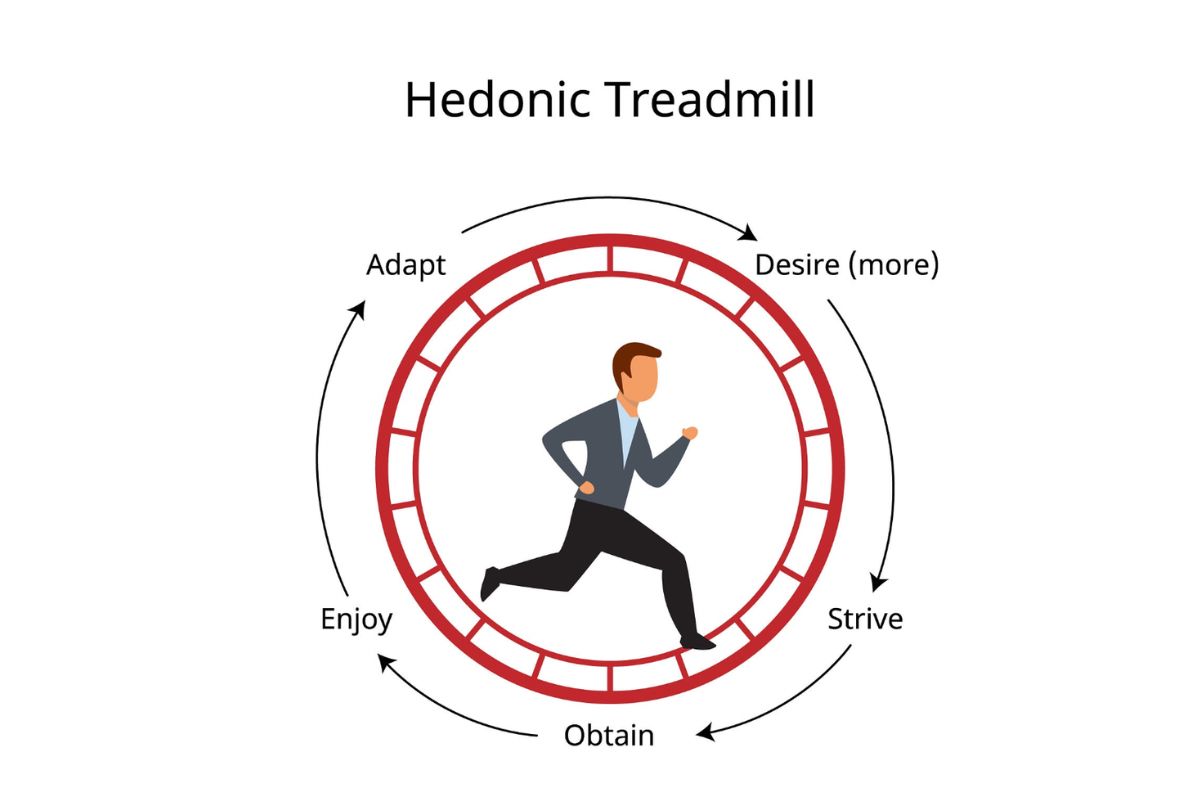
Similarly, when you are walking on a physical treadmill, it does not matter how fast you run; you will eventually find yourself right back where you started. And this concept is known as the hedonic treadmill. That treadmill affects almost every area of our lives, whether we are buying things, getting into a relationship or chasing a goal. Our brains normalize our circumstances, turning luxury into baseline necessity, and we stay unsatisfied. Let's learn the science behind these fulfilled desires.
Also read || How AI Predicts Autoimmune Disease Before Symptoms Appear
What are Hedonics?
One can't manage the hedonic treadmill without knowing what "hedonic" actually means. Becker et al.(2019) found that hedonics are experiences of pleasure and displeasure, which serve as core processes and central components of emotional responses. We often link "hedonism" with a wild, self-indulgent search for sensory pleasures. However, the term is much broader and refers to the positive and negative valences that accompany our emotions, motivations and physical states.
Scientists differentiate between two types of happiness: the first is hedonic well-being, and the other is eudaimonic well-being. In the Annual Review of Psychology, Ryan and Deci (2001) found that hedonic well-being is a form of happiness focused on pleasure attainment and pain avoidance. On the other hand, eudaimonic well-being is about the degree to which a person is fully functioning, focusing on meaning, self-realization, and fulfilling one's true nature.
In a simpler example, when you eat a delicious slice of pizza, play a video game or buy new clothes, that's all hedonic well-being, and it feels great for a moment. In contrast, learning a new language, volunteering in your community or working hard to achieve a personal goal represents eudaimonic well-being. Though eudaimonic tasks are difficult, they add a sustained sense of growth and authenticity, whereas hedonic activities have a short-lived impact.
Hedonics in Our Daily Life
The hedonic treadmill is not some fancy concept; it exists everywhere around us, and we all face it at some point in our lives. In a Psychology Today article by Abigail Fagan, it was found that starting a new romance or being promoted at work causes a brief burst of extra joy. Yet, these changes do not transform our everyday level of happiness in the long run because we quickly adjust our expectations to the new status quo and start desiring even more.
You can call it a classic "honeymoon phase" in relationships. It's found that couples eventually start taking the positive aspects of the relationship for granted, which settles their excitement to a baseline. The same thing happens when you get rich: you feel good initially, thinking that money would be a solution to your happiness, but it doesn't last for long. According to Psychology Today, it is found that higher incomes correspond with higher well-being only up to about $95,000; after that, emotional gains plateau, and we settle at the baseline happiness.
In the Becker et al. (2019) research paper, it is found that our retrospective evaluation of affective episodes does not rely on the average feelings of the entire duration, but rather on the average of the most intense feeling (the "peak") and the feeling at the end of the episode. For example, you go to an average concert. Still, it had an exceptional solo performance by a guitarist (the peak), and it ends with your favorite song; you will remember the entire concert as being fantastic, and the same thing happens with movies.
Also read || 5 Surprising Realities of the AI Drug Discovery Revolution
What the Brain Research Actually Says
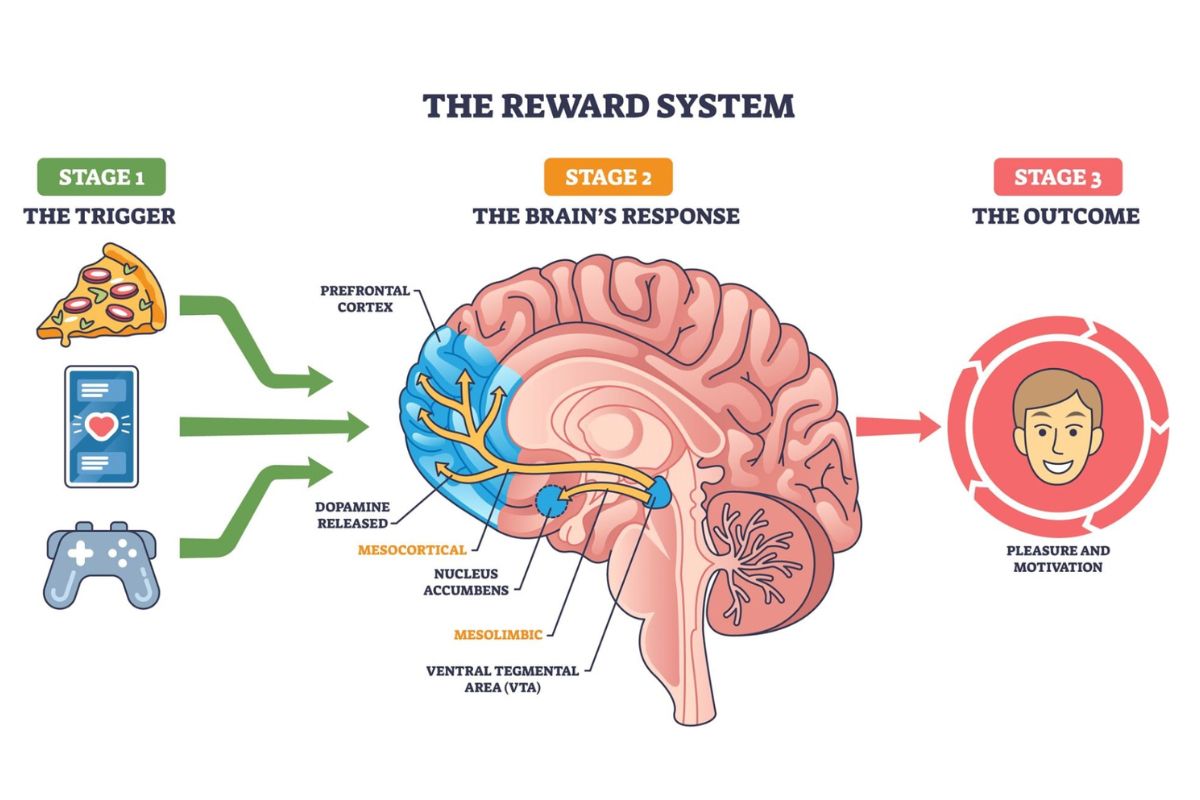
Now, let's understand what actually happens in our brain, or how it generates these experiences of pleasure and desire. For several years, popular culture has labeled the neurotransmitter dopamine as the "happy chemical"; you have probably heard of getting a "dopamine hit" from social media. But neuroscientific research has completely overturned this myth.
It has been found that dopamine does not drive the actual hedonic experience of pleasure, but instead drives the motivational purpose to obtain a reward. This implies that dopamine is nothing more than a chemical of anticipation, desire, and craving rather than satisfaction. It keeps us searching and striving, which is why we often feel a strong urge to buy something, only to feel empty or indifferent once we actually possess it.
So, if dopamine is responsible for wanting, what is responsible for liking? In a study by Becker et al. (2019), positive hedonic responses ("liking") are specifically generated by endogenous opioids located in tiny, localized brain regions called hedonic hot-spots. These hot-spots are found inside structures like the nucleus accumbens, the ventral pallidum, and the parabrachial nucleus. So, when we consume something enjoyable, like sweet food or a comforting touch, these hot-spots light up, releasing natural opioids that create the actual sensation of pleasure.
The most interesting thing about this system is its dynamic and flexible nature, and it operates like an "affective keyboard." Becker et al. (2019)'s research shows that stress, environment and expectations can retune our neural circuits and shift our responses between desire and fear. As a result, our mindset physically alters how we experience pain or pleasure. Interestingly, your brain can release natural opioids through placebo effects, which reduce physical pain and enhance pleasure to match our mental state.
Also read || Is an IQ Test a Real Measure of Intelligence?
Why it Matters for You
Now that you know the science, can you use this information to make your life happier? The answer has nuances. You cannot stop the treadmill. Thus, you have to manage it intelligently. You need to include variety and novelty in your life. According to Psychology Today, when you mix up the elements of your positive experiences, it prevents them from becoming monotonous. Hence, it slows down the process of hedonic adaptation.
For instance, you go to your favorite restaurant every single week, and you lose interest in the food as well as the ambience over time. Thus, trying different dishes or different restaurants can keep your experience fresh. One must start enjoying their positive moments. Research suggests that consciously focusing on positive experiences leads to long-lasting positive feelings. So, put away your phone, take a breath, and focus on the good times while they are happening.
In the end, we must concentrate on intrinsic rewards over extrinsic rewards. Ryan and Deci's research in 2001 found that too much emphasis on materialistic goals like wealth, image, and popularity leads to lower well-being because these goals do not satisfy our basic psychological needs. However, when we focus on intrinsic rewards such as autonomy, competence, and relatedness, we naturally cultivate eudaimonic well-being. So, focus on personal growth, authentic friendships, and meaningful contributions, and you will step off the hedonic treadmill.