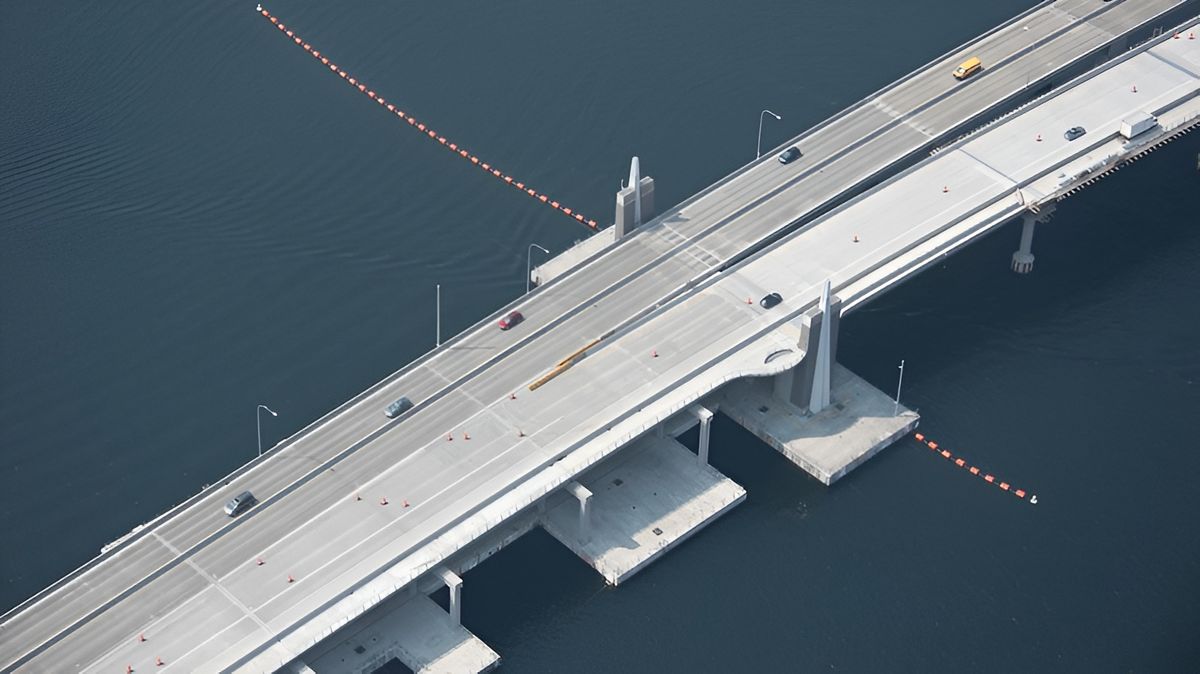
Most drivers crossing Seattle’s SR 520 floating bridge think they are on a standard highway. They set their cruise control, turn up the radio, and feel solid asphalt under their tires. But looking out the window reveals a remarkable civil engineering feat: there are zero solid pillars beneath the road, and the water below reaches depths of 200 feet.
Instead of resting on stone towers, this highway behaves like a massive concrete boat. Stretching 7,710 feet across Lake Washington, the SR 520 Governor Albert D. Rosellini Bridge holds the official Guinness World Record as the longest floating bridge on Earth.
But why is the 520 bridge a floating bridge instead of a traditional suspension structure, and how does concrete actually float?
The answer to this lies in Lake Washington’s unique geology, Archimedes' principle, high-stakes political battles, and a century of groundbreaking marine engineering.
How Traditional Bridges Support Highways
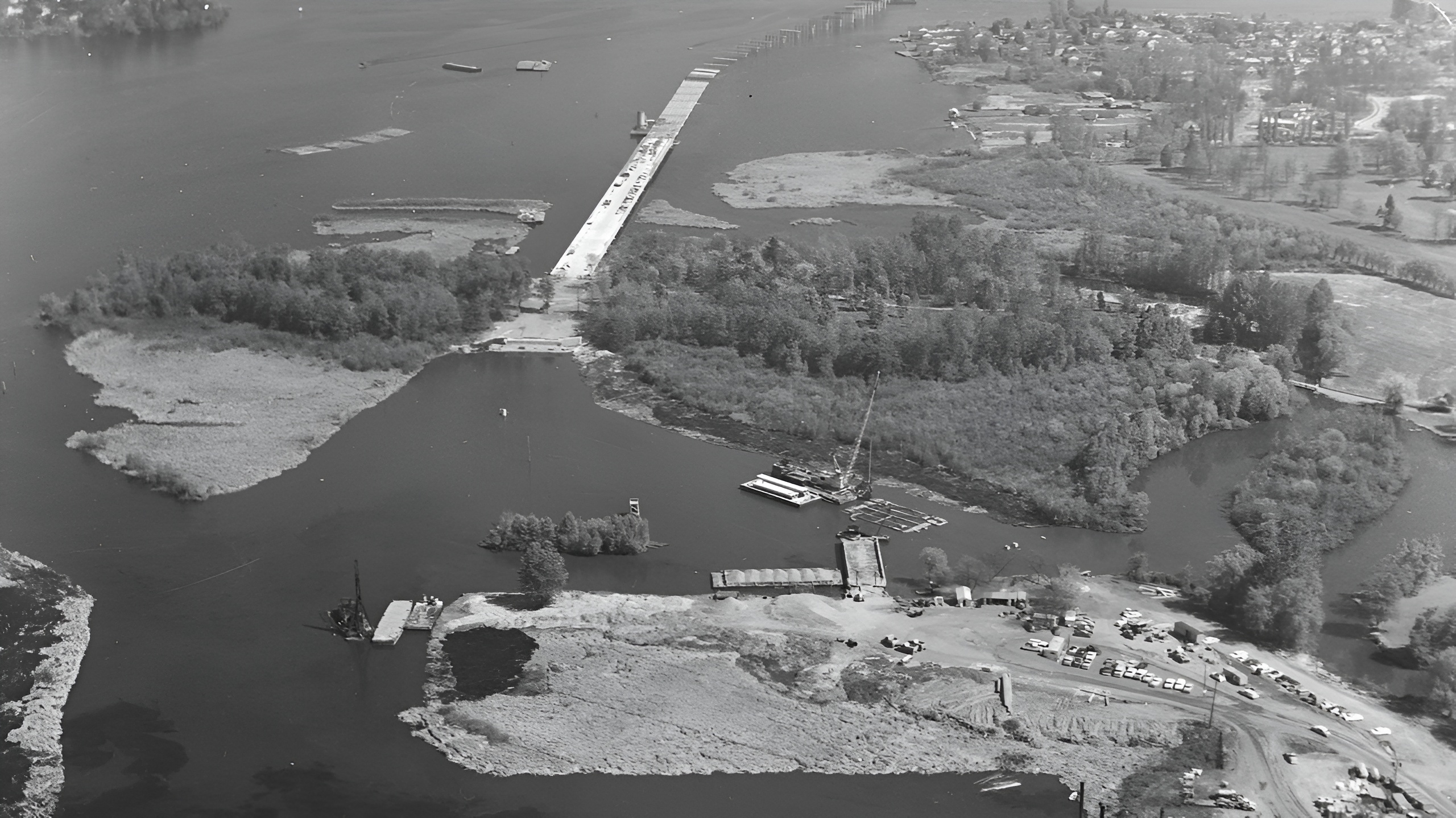
In the 1950s, Seattle residents assumed state planners would follow this exact blueprint. The post-World War II regional economy was booming, driven by aerospace jobs at Boeing. As families moved across Lake Washington to farmland towns like Bellevue and Redmond, those communities rapidly transformed into suburbs.
Standard civil engineering relies on a predictable model to span bodies of water:
Drive Deep Foundations: Engineering crews drive steel piles or sink thick concrete piers into the riverbed or ocean floor.
Build Tower Anchors: Teams erect support towers on top of these piers to anchor steel cables or load-bearing girders.
Pave the Deck: Crews lay a multi-lane roadway across the structured frame.
However, Lake Washington stood directly between these new suburban neighborhoods and Seattle's economic core. Commuters relied on slow ferries or a single, overcrowded bridge to the south. As traffic congestion mounted, regional leaders needed a direct east-west highway connection across the lake.
Also Read: Why Toyotas Never Die: The Engineering Secret To 500,000 Mile Reliability
Why Is the SR 520 Bridge a Floating Bridge? The 3 Core Challenges
When civil engineers evaluated Lake Washington for a standard suspension or truss bridge, conventional piers proved physically impossible and financially prohibitive.
| Engineering College | Impact on Traditional Bridge Design |
| Extreme Water Depth & Silt |
Lake Washington is 200 feet deep along the crossing path, with an additional 100 feet of soft, watery silt before reaching bedrock. |
| Financial & Federal Rejection | President Dwight D. Eisenhower's administration declined to find the project because it wasn't part of the original Interstate Highway System layout. Washington State had to take a massive gamble and raise $24.7 million independently via revenue bonds. |
| Route Controversies | The alignment cut through Montlake and the Washington Park Arboretum. Lawsuits and property disputes delayed construction for years, requiring a design that could be assembled rapidly once approved. |
How Do Concrete Floating Bridges Work? The Archimedes Solution
The solution came from a visionary engineer named Homer Hadley. In the 1930s, Hadley proposed building a floating highway constructed from hollow concrete boxes. Having worked with concrete barges during World War I, Hadley understood fluid dynamics and buoyancy.
Archimedes' principle states that any object will float if it displaces a volume of water equal to its own weight. Even though concrete is dense, a hollow concrete pontoon filled with air weighs significantly less than the volume of water it displaces.
When Hadley first presented his idea, critics mocked it as "Hadley's Folly," predicting a "chain of concrete scows" would sink during the first winter storm. His theory proved its worth when Seattle opened the world's first major floating concrete bridge, the Lacey V. Murrow Memorial Bridge (I-90) in 1940.
The Political Gamble Behind the 1963 Span
When suburban growth exploded in the 1950s, state leaders didn't want to gamble on conventional deep-water piers. Instead, Governor Albert D. Rosellini (D-WA) championed Hadley's proven floating model to forge the SR 520 corridor. Because federal highway authorities had refused to foot the bill, Rosellini's administration took on $24.7 million in state public bond debt (over $250 million in modern currency) to finance construction independently.
Modular Marine Assembly Process
Pontoon Casting: Local shipyards poured concrete into massive, hollow, watertight molds.
Towing & Alignment: Tugboats towed the air-filled pontoons into position across Lake Washington.
Securing the Span: Workers bolted pontoons end-to-end, sealed the structural joints, and dropped 100-ton concrete anchors to the lakebed, attaching them to the bridge with thick steel cables to prevent lateral sway.
When the Evergreen Point Floating Bridge officially opened on August 28, 1963, during President John F. Kennedy’s administration, it was celebrated as a triumph of local political grit and creative engineering. The traffic volume was so high that Washington State paid off its construction bonds years early and removed driver tolls by 1979. (In 1988, the span was officially renamed the Governor Albert D. Rosellini Bridge in honor of his leadership.)
Upgrading the SR 520 Bridge for the Modern Era
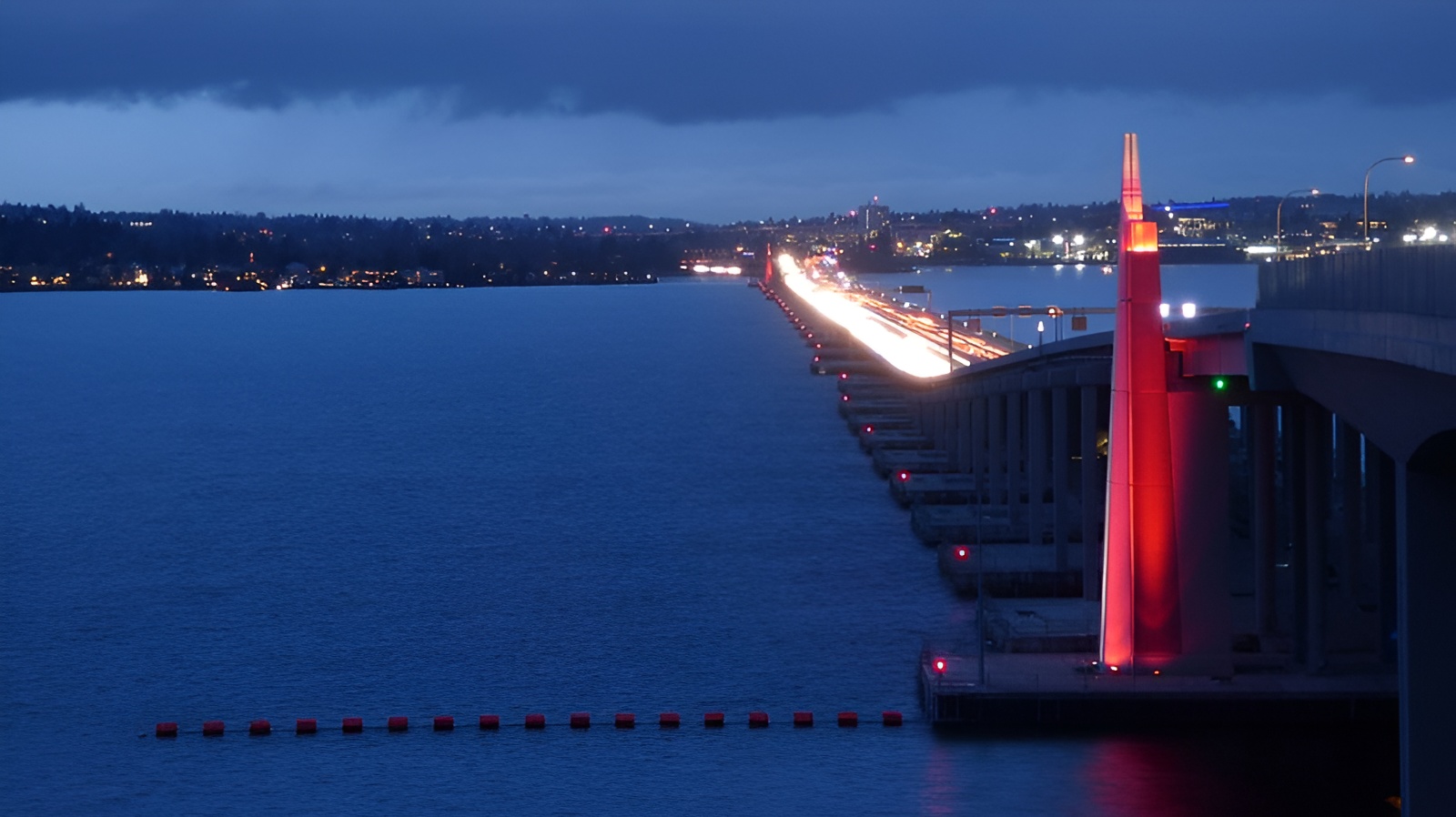
By the early 2000s, the 1963 bridge was approaching the end of its 50-year design lifespan. The structure sat low in the water, lacked emergency shoulders, and featured a mechanical drawspan that frequently halted highway traffic. More critically, decades of wave action had degraded the pontoons, leaving the roadway vulnerable to severe windstorms or earthquakes.
Under Governor Christine Gregoire and later Governor Jay Inslee, alongside federal grant and TIFIA loan support during President Barack Obama’s administration, the state launched a massive $4.56 billion corridor overhaul.
Therefore, between 2012 and 2016, crews built a state-of-the-art $1.5 billion floating replacement structure.
Key Improvements of the Modern Span
77 High-Tech Pontoons: The foundation relies on 77 massive, watertight concrete pontoons equipped with internal leak-detection sensors and post-tensioned steel tendons to resist seismic forces.
Elevated Roadway Deck: Concrete columns raise the driving deck 20 feet above the floating pontoons, allowing storm waves to pass safely beneath the highway without splashing onto vehicles.
Eliminated Drawspan: The replacement eliminated the old mechanical drawspan, replacing it with a fixed, elevated transit section on the east end that lets marine vessels pass without interrupting traffic.
Recycled Infrastructure: When crews dismantled the 1963 span, the original concrete pontoons were towed across the Pacific Northwest for reuse as floating breakwaters, docks, and marine barriers.
Also Read: Scarcity Marketing: How Limited Edition Drive Sales
The Global Legacy of Seattle's Floating Highways
What began as an idea ridiculed by critics in the 1930s turned into one of the most practical engineering accomplishments in modern infrastructure history. By choosing not to fight 300 feet of deep water and liquid mud, engineers realized a fundamental truth: when you cannot anchor to bedrock, floating on top of the water is the smartest way forward.
Today, the world’s longest floating bridge carries roughly 74,000 vehicles across Lake Washington every weekday. Drivers travel smoothly over asphalt without ever noticing the 77 giant concrete pontoons and massive steel anchors working beneath the surface.
As coastal cities worldwide confront climate change, rising sea levels, and complex deep-water transit needs, Seattle’s floating highway serves as a proven blueprint for modern civil engineering on the water.