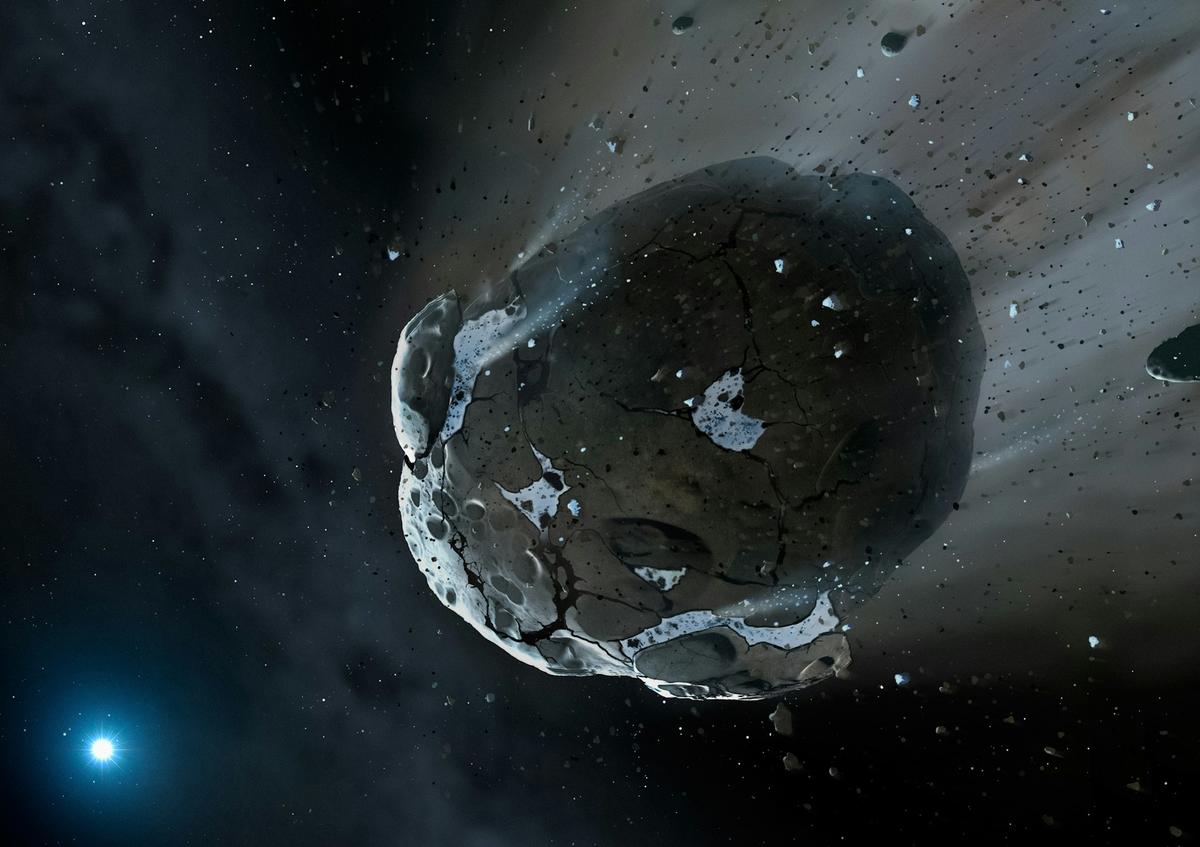
Every year on 30th June, space agencies, scientists, educators, and curious minds across the world unite to observe World Asteroid Day, which is also called International Asteroid Day. But why is it celebrated? What's the history behind it, and what is its significance to us? Let's decipher one by one. World Asteroid Day is a United Nations-sanctioned global awareness campaign to educate people about asteroids.
The UN uses this day to inform people about what asteroids are, their risks to Earth, and what humans are doing to track, study, and potentially deflect them, and save the Earth. Interestingly, iconic Queen guitarist and astrophysicist Brian May, along with astronaut Rusty Schweickart, filmmaker Greg Richters, and B612 Foundation president Danica Remy, are credited as co-founders of this movement. Stephen Hawking backed this global movement and is now observed in 78 countries across the world.
Also read || How John Young Smuggled a Corned-Beef Sandwich into Space
The Tunguska Event: The History That Shook the World

Picking 30th June was not a random decision, and there is a history behind it. In 1908, a massive asteroid fragment exploded over the remote Podkamennaya Tunguska River region of Siberia, Russia. 80 million trees fell instantly, and the blast had a range of 2,150 square kilometers. It is still considered one of the most dramatic moments in modern history, and remains the most powerful asteroid-related explosion in human history.
What makes this event unique is that the comet or asteroid fragment never actually hit the ground, and exploded mid-air, releasing energy closer to the force of the Hiroshima atomic bomb. The explosion was heard as far as 800 kilometers away from the incident site, shattered windows within a 200-kilometer radius, and shockwaves were felt in Northern and Central Europe. Had the same object detonated over a densely populated region, the death toll would have been catastrophic.
Also read || Why Do Rockets Curve as They Go Up?
Another similar event happened in 2013 in Chelyabinsk, Russia. A 20-meter asteroid exploded over Russia, injuring approximately 1,500 people from shattered glass alone. These events reinforced the long-standing argument of planetary scientists who believed that asteroid impacts are not a distant theoretical scenario, and something needs to be done to prevent them. And that built the foundation for World Asteroid Day.
It took a while, and in December 2016, the United Nations General Assembly officially proclaimed 30th June as International Asteroid Day. In that resolution, they called all UN member states, international organizations, and civil society to observe it annually. For the first time, a global governing body formally acknowledged asteroid impact risk as a matter requiring coordinated scientific research, global attention, and sustained public education.
Why World Asteroid Day is Celebrated

People may argue that it isn't strange to celebrate a day that could have been a catastrophe. However, we often ignore that an asteroid hit is the only major natural disaster we can predict and prevent if we have the right set of tools and technology. Unlike tsunamis, volcanic eruptions, or earthquakes, comet or asteroid threats are trackable.
The International Asteroid Day amplifies the urgent case of investing in planetary defense systems, near-earth object monitoring networks, and international coordination for emergency response. The day features the 100X declaration, which urges governments and space agencies to increase asteroid detection rates by 100 times within a decade. So far, scientists have only catalogued a fraction of the near-earth asteroids large enough to cause significant regional or global damage.
Expansion of that asteroid catalogue would be a priority in building a serious, credible planetary defense strategy for the future. Beyond defending, World Asteroid Day is also celebrated as a genuine frontier. These rock
Beyond defense, World Asteroid Day also celebrates asteroids as a genuine scientific frontier. These rocky remains from the solar system's formation 4.6 billion years ago carry irreplaceable clues about how planets formed, how water reached Earth, and how organic molecules — the building blocks of life — may have traveled across the cosmos. It reshapes what we know and think about the early solar system.
Also read || Jim Lovell: From Apollo 13 to Artemis II
World Asteroid Day 2026: When, Where, and What to Expect
On Tuesday, 30th June, World Asteroid Day will be celebrated, and it will be the 118th anniversary of the infamous Tunguska Event. The official flagship celebration is being held in Luxembourg on June 26 and 27, with the Asteroid Day Festival taking place at Cercle Cité. You can live-stream the selected sessions via Asteroid Day's digital platforms, such as Asteroid Day's official YouTube Channel, Asteroid Day website, NASA, and European Space agencies' webcasts.
Renowned astronomer Gianluca Masi will host a live night-sky exploration featuring telescope observations and expert discussions on 26th June. And on 27th June, Saturday, there will be a Space Lecture at Cercle Cité, which will have scientists, students, and space enthusiasts for case studies and networking. Moreover, the festival will also have astronaut meet-and-greets, interactive educational panels, and a closing Art and Science performance for the best space science storytelling.
In Arizona, United States, the Asteroid Day event will feature Apollo 9 astronaut Rusty Schweickart, NASA astronauts Steve Smith, Nicole Stott, and Ed Lu, plus science communicator Scott Manley. There will be events including guided crater experiences, astronomy talks, family activities, and the announcement of the 2026 Schweickart Prize, which is given for the most compelling and innovative planetary defense proposal from the global scientific community.
Beyond Luxembourg and Arizona, there will be independent events worldwide, including school workshops, stargazing nights, documentary screenings, virtual webinars, and maybe social media challenges using #AsteroidDay2026. The Asteroid Day website features a "Find an Event" section where all the big events are happening globally.
Also read || SpaceX Starship V3: Why the May 2026 Delay is a Win
The Bigger Picture: Why Asteroids Matter More Than Ever
The universe does not stop for anyone, and we are living in the most consequential era of planetary defense science in human history. In 2022, NASA's Double Asteroid Redirection Test (DART) successfully altered the orbit of Dimorphos, proving that humans can physically deflect a space rock on purpose. The European Space Agency's Hera mission was launched in 2024 to travel and study the Dimorphos impact site in detail, which will have groundbreaking data for future deflection missions worldwide.
Besides, Asteroid Apophis is a concern for the world, as this 375-meter near-earth Asteroid will pass closer to Earth than many of our own satellites in April 2029. It would be a rare and scientifically invaluable opportunity that space agencies are preparing for. While no impact is predicted, Apophis being visible with the naked eye makes it the most closely observed flyby in history.
Eventually, World Asteroid Day reminds us of our shared vulnerabilities and how science can help us solve problems with collaboration and curiosity rather than paralyzing fear. Every year, we're losing time but becoming a little more capable. Asteroids are real, their impact is real, and we are not in a science fiction film.