
You pick a college major thinking it's a personal choice, only to realize that it was one of the biggest financial bets for your career. People often undermine the value of a degree, but it is undoubtedly a huge investment in your future earning potential. Love them or hate them, STEM degrees (science, technology, engineering, and math) usually pay off more than other majors.
A STEM degree acts like a "stability shield," and it's not only about earning more, but also about protecting people when the economy takes a hit. When you have strong job security and high pay, you need nothing more on rainy days. So, picking up STEM is not just a career advice cliché. Georgetown University Center on Education and Workforce implies that STEM and Business majors together make up 46 percent of all college graduates.
The notion of this article is not to undermine humanities or non-STEM majors, but the world runs on supply and demand. When you see almost half the population choose fields tied directly to market demand, it is not a coincidence. It is how the world works; people usually choose options where the money and the job security actually are.
Also read || Is Blue Light or Doomscrolling Ruining Your Sleep?
The Money Gap Is Greater Than You Think
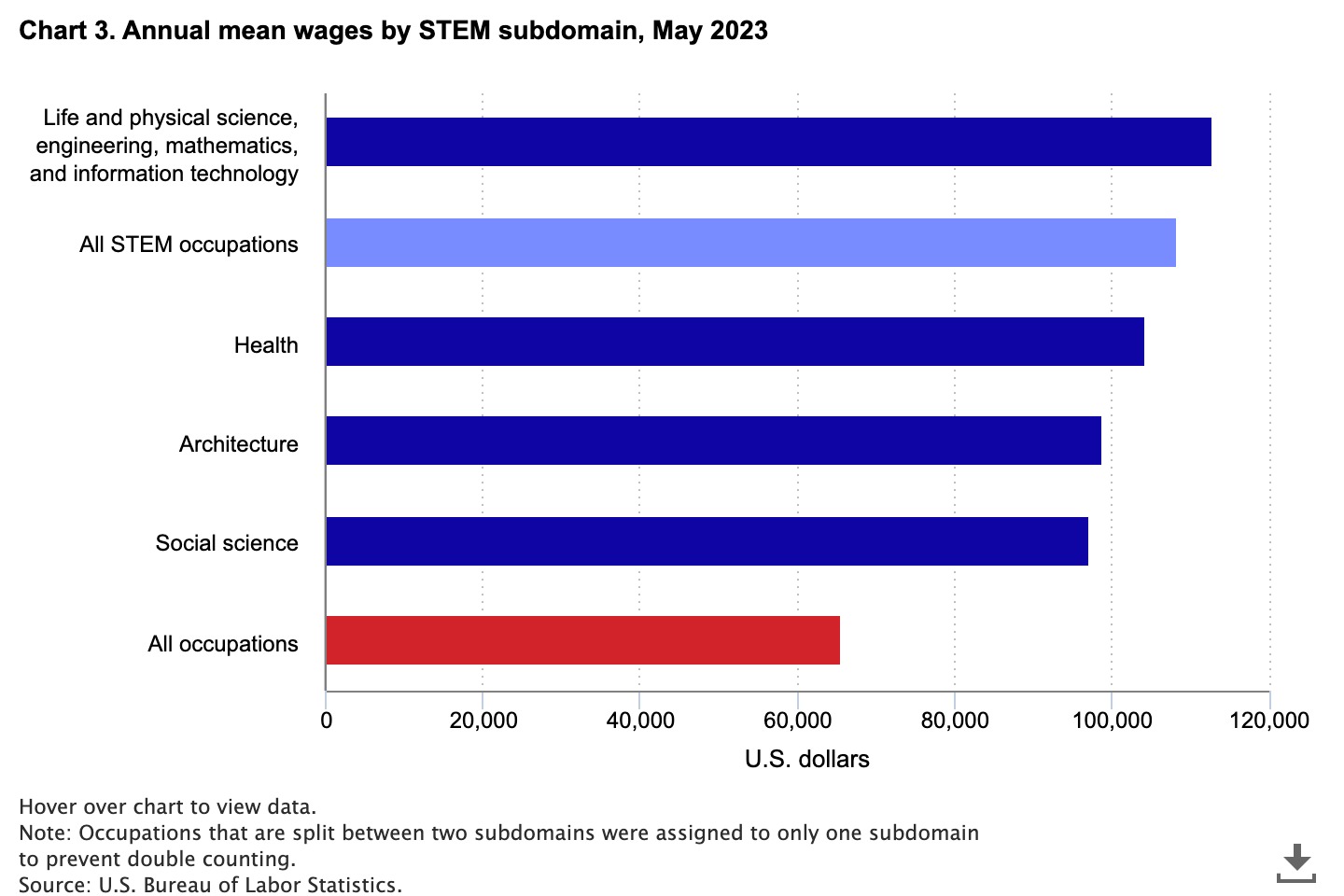
CEW Georgetown report found that graduates with the highest-paying majors can earn $3.4 million more over a lifetime than those with the lowest-paying ones. The gap is significant, and that is what determines whether you'll have to work all your life or have a comfortable retirement, planning well into your 50s.
STEM, health, and business majors have an edge. The same Georgetown University report shows that graduates with these degrees can have entry-level wages of $37,000 or more, climbing to career averages of $65,000 or higher. So, when you compare that to career averages in early childhood education or theology, which are $39,000 and $43,000, respectively, the gap becomes unignorable. The gap becomes unignorable.
Compare them with specific science and engineering (S&E) jobs, and you'll be even more shocked. National Center for Science and Engineering Statistics (NCSES) and the Bureau of Labor Statistics (BLS) revealed that the median salary across all S&E occupations hit $88,720 in 2019, while the median salary for U.S. workers was just $39,810 in that year. In short, some STEM workers earn more than double that of others.
If you think people get paid only for their four-year degrees or Masters, you are wrong. According to NCSES data from 2019, a STEM worker without a bachelor's degree earns around $43,200, while the same non-STEM worker without a bachelor's degree can earn around $27,000. Moreover, STEM graduates will earn $78,000, while non-STEM graduates can earn around $53,000. The data may be from 2019, but it's still quite relevant.
Recession-Proof: How STEM Held Up During COVID-19
The goal of a job is not just to earn money but to have stability when things go crazy. So, people were concerned about their jobs during the COVID-19 pandemic, which eventually became a real-world test of what careers truly stand for. Fortunately, most STEM workers succeeded in that test.
According to NCSES data, unemployment for non-STEM workers hit 16 percent in 2020, while STEM unemployment was just 9 percent during the same time. So, employment is not guaranteed, but the chances of getting a job are better when you're in a field that was supposedly "just for nerds."
Moreover, the same NCSES report shows that STEM workers without a Bachelor's degree were also part of the Skilled Technical Workforce (STW). So, these were people working in healthcare, construction, manufacturing, and repair roles. Their unemployment peaked at 12.8 percent in 2020, while the non-STEM workers without a degree had 19.3 percent unemployment.
Before someone calls it a pandemic fluke, let's understand what happened before 2019. The STEM unemployment rate was 2.2 percent, which was well below the unemployment rate for the overall U.S. workforce, i.e., 3.7 percent. Furthermore, during the same time, computer and mathematical scientists had a median salary of $103,900, implying that STEM pays well even in ordinary economic conditions.
Also read || Why You Procrastinate & How to Beat It Today
STEM Grads Don't Just Work in Labs

Some people feel that getting a STEM degree would lock them into a lab coat and microscope for life, which is a big myth, since STEM is not only about pure research. NCSES shows that around three-fourths of workers with STEM bachelor's degrees end up working in the business sector. The analytical, problem-solving skills built via STEM education are quite transferable in most businesses.
Lauren Harris of Yale University observed that when STEM graduates pivot away from traditional science careers and get into non-STEM graduate degrees, 47.55 percent of them move into healthcare roles, while another 26.86 percent move into management and administration, usually rising into executive positions. She calls this pattern a "leaky pipeline."
In other words, even when STEM grads "leave" the field, they don't lose their edge. Her data implies that around 8.82 percent of career-switchers from STEM frequently land in some of the highest-paying jobs available, including top-level management. So, a STEM foundation keeps paying off, just from a different address.
Yale's research also shows an interesting fact about workplace culture. While fields like computer science have a smaller number of women in the workforce, job switching is driven by pay gaps and slower promotions. Conversely, gender parity is shrinking in Life Sciences, where women earned 58.1 percent of Bachelor's degrees. This pattern suggests that after reaching a "critical mass" of representation, stronger support systems are naturally built to keep more people in the pipeline.
The strange thing about STEM talent is its geographical clustering and clustering into a few key industries, such as scientific and professional services, manufacturing, information, education, and government. There are geographical clusters like Maryland, Massachusetts, Washington, and Washington, D.C. In NCSES 2021 data, 16 percent of the entire workforce in D.C. works in a STEM occupation, which is why the city was a genuine STEM hub.
The question is: does clustering matter? For anyone thinking about where to build a career, not just what to study, clustering is important. While a STEM degree opens doors in almost every part of the country, it opens them widely in places where innovation industries are already concentrated. So, it is worth considering where you want to start your career or where you can get the best chances. Currently, Texas, Florida, and California have roughly 26% of the entire U.S. STEM workforce combined.
Also read || 7 College Majors Still Winning in the AI Job Market
Why should one choose STEM?
When we put all of this together, we get reasons that are hard to refute. STEM degrees offer a rare combination: a strong paycheck, widening earnings over a lifetime, and a real cushion against the kind of economic shocks that kill industries overnight. Even if you switch careers from STEM to non-STEM, you won't be at a disadvantage, which makes it a decent choice.
Does it mean that you should stop caring about your passion or interest? The answer is no. Every industry needs writers, teachers, artists, and caregivers to function, but you should consider financial consequences. Data repeatedly shows that STEM does not just build skills; it also builds protection against the difficult days. So, a student who is seeking a combination of better financial stability, careers, and opportunities can consider STEM.
Non-STEM fields still have value, as they develop essential human skills like creativity, empathy, strategic communication, and ethical reasoning, which are unreplicable for machines. But when the numbers show a $3.4 million lifetime gap, employment cushion, and a premium salary, it is obvious why so many parents, students, and career consultants want people to go for sciences.