During World War II, which lasted from 1939 to 1945, many aircraft played important roles in the war between the Allied countries and the Axis countries. Two of the most famous Allied aircraft were the American P-51 Mustang and the British Supermarine Spitfire. These aircraft became famous because of their speed, weapons, range, and ability to fight at high altitudes. However, an aircraft also needs a good engine to perform well.
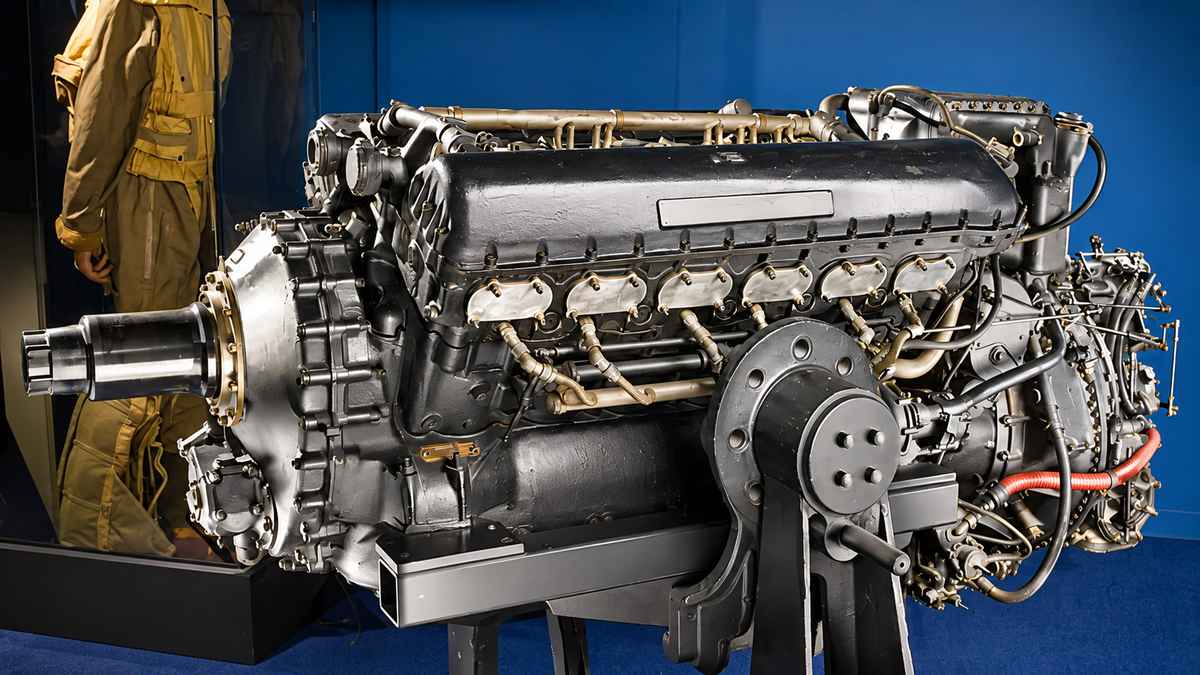
One of the most important aircraft engines of World War II was the Rolls-Royce Merlin. The Merlin was a powerful 12-cylinder engine. It was used in many famous aircraft, including the Spitfire, P-51 Mustang, Avro Lancaster, and de Havilland Mosquito. Its ability to provide strong and reliable power at different heights made it extremely useful during the war. The Merlin was first produced in 1936, before World War II began, and production continued until 1956. During those years, it was built in many versions and was used in a large number of aircraft.
The P-51 Mustang and the Spitfire
The North American P-51 Mustang is considered one of the greatest fighter aircraft of World War II. The P-51D, in particular, became one of the most successful versions of the Mustang. Many people consider the P-51D one of the important technical reasons why the United States was able to win the air war over Europe against Germany, which was ruled by the Third Reich. The Mustang was fast, could fly long distances, and could operate at high altitudes. These qualities made it very useful for protecting Allied bombers during missions over Europe.
The Mustang has also been credited with shooting down the Messerschmitt Me 262 in air-to-air combat. The Me 262 was a German aircraft and was the world's first operational jet fighter. The British Supermarine Spitfire was another famous Allied fighter. The Spitfire was used by the Royal Air Force, or RAF, and played an important role in defending Britain against attacks by the German Luftwaffe. The Spitfire became especially famous during the Battle of Britain in 1940, when Britain fought to defend itself against German air attacks. The Spitfire is also well known in popular culture. A Spitfire defending Britain is the subject of Iron Maiden's song "Aces High."
The P-51 Mustang and Spitfire served their countries during the war. They also had an important connection because several versions of both aircraft used the Rolls-Royce Merlin engine. The P-51 did not use a Merlin engine made directly by Rolls-Royce. Instead, the American company Packard produced a licensed version of the Merlin for the United States. The Merlin was made in many different versions before and during World War II. It was used in many aircraft that helped the Allies in the war.
What Was the Rolls-Royce Merlin?
The Rolls-Royce Merlin was a 12-cylinder, liquid-cooled, supercharged piston engine. It had a displacement of 1,649 cubic inches, which is about 27 liters. The engine first entered production in 1936 and continued to be produced until 1956.
The Merlin was originally a British engine. Early aircraft that used it included the Hawker Hurricane and the Supermarine Spitfire. As World War II became more intense, the need for Merlin engines increased. American companies also became involved in production. One of the most important American companies was Packard, which produced the Merlin under license. The American-built Merlin was given the name V-1650. This American production was important because it allowed large numbers of Merlin engines to be supplied for aircraft such as the P-51 Mustang.
Also Read: How Rolls-Royce Ran on Fuel Made from Plastic Waste
Why Was the Merlin Important?
Aircraft engines used during wartime had to work under very difficult conditions. A fighter aircraft could climb quickly, fly at high speed, turn sharply, dive, and fight another aircraft. The engine had to continue working during all of these actions. The engine also had to work at different heights. This was especially important because the air becomes thinner as an aircraft climbs higher. An engine needs enough air to produce power.
The Merlin used a supercharger to help solve this problem. A supercharger forces more air into the engine. This allows the engine to maintain better power at high altitude. The Merlin was improved over time so that it could work effectively at different heights and in different conditions. This ability became one of the engine's most important strengths.
The Merlin and the Spitfire
The Merlin was used in the Spitfire from the early years of the aircraft's development. From the beginning of World War II, the Merlin performed well in Spitfires, especially at high altitudes. However, the early versions of the engine had some problems. The fuel system and supercharger could have difficulties when the aircraft was flying at lower altitudes and making fast combat movements.
Fighter combat often involved sharp turns, quick climbs, dives, and other sudden movements. These actions placed a lot of pressure on the engine and its systems. British engineers continued to improve the Merlin. Over time, many of these problems were solved. The improved engine helped the Spitfire become a stronger and more reliable fighter. The Spitfire was then able to compete more effectively against Germany's Messerschmitt Bf-109, one of the Luftwaffe's main fighter aircraft.
The Merlin Comes to the P-51 Mustang
The P-51 Mustang did not originally use the Merlin engine. The first P-51s were powered by an Allison engine. The Allison engine had a major problem because its performance dropped at high altitude. This was a serious problem because high-altitude performance was very important for fighter aircraft operating over Europe.
The Merlin had better high-altitude performance. Because of this, the United States Army Air Forces decided to use the Merlin in the Mustang. At that time, the United States Air Force did not yet exist as a separate military branch. The United States Army Air Forces operated America's military aircraft.
The American company Packard built a licensed version of the Merlin. The Mustang fitted with the Merlin became the P-51B and P-51C, followed by the P-51D and other versions. The P-51D became one of the most famous versions of the Mustang. The combination of the Mustang aircraft and the Merlin engine created one of the most successful fighter aircraft of World War II.
The Merlin Made the P-51D a Powerful Fighter
The Merlin engine greatly improved the Mustang's performance. The P-51D became one of the most successful American fighter aircraft of World War II. During the last full year of the war, P-51 Mustangs were credited with 4,950 air-to-air victories in Europe, according to the figures associated with the original account.
The Merlin engine used in the Mustang produced about 1,695 horsepower. This allowed the P-51D to reach a top speed of about 437 miles per hour. It could reach a combat ceiling of about 41,900 feet.
The German Messerschmitt Bf-109, depending on its version, had a top speed of about 426 miles per hour and a ceiling of about 41,400 feet. The Bf-109 also used a 12-cylinder supercharged engine. The Merlin therefore gave the P-51D very strong performance against German fighters. The Mustang's long range was also extremely important. It could accompany Allied bombers deep into German-controlled territory and help protect them from enemy fighters. This made the P-51 one of the most important Allied fighter aircraft in the European air war.
The Merlin and the Spitfire's Weapons
The Merlin was not only important because it helped the Spitfire fly fast. It also gave the aircraft enough power to carry a large amount of weapons. Before the P-51D arrived in 1944 with its improved engine, British engineers had already been working for years to make the Merlin-powered Spitfire useful in different parts of the war.
The Royal Air Force needed aircraft that could fight in different environments. British aircraft had to fight German aircraft in Europe. They also had to operate against Japanese aircraft in other parts of the war. Because of these different needs, many versions of the Spitfire were developed.
One important version was the Spitfire Mark V. The Mark V could carry a large amount of weapons. Depending on its setup, it could carry as many as eight machine guns. It could also be fitted with four 20-millimeter cannons and four machine guns. This gave the aircraft a large amount of firepower.
For comparison, the Japanese Mitsubishi A6M Zero normally carried two 20-millimeter cannons and two machine guns. The Messerschmitt Bf-109 carried different weapons depending on the version, but many versions carried a cannon and two machine guns. The Merlin provided the power needed for the Spitfire to carry its weapons while still performing its role as a fighter.
Also Read: How an 1816 Engine Led to the Refrigeration Revolution
The Merlin Was Also Used in Bombers
The P-51 Mustang and Spitfire were the most famous aircraft powered by the Merlin. However, the engine was also used in several other important aircraft. Two of the best-known examples were the Avro Lancaster and the de Havilland Mosquito. Both aircraft played important roles in the Allied war effort.
The Avro Lancaster
The Avro Lancaster was a British heavy bomber. It became one of the main heavy bombers used by Britain's Royal Air Force during World War II. The Lancaster helped the Allies carry out bombing attacks against German targets. These missions were aimed at important targets connected to Germany's military and industrial activities.
The Lancaster also formed an important part of the Allied bomber force alongside aircraft such as the American B-17 Flying Fortress. The Lancaster was powered by four Merlin engines. Four engines gave the large aircraft the power it needed to carry heavy bomb loads and fly long distances. The Merlin therefore played an important role in allowing the Lancaster to carry out bombing and reconnaissance missions.
The de Havilland Mosquito
The de Havilland Mosquito was another important aircraft powered by the Merlin. The Mosquito was unusual because it was made mainly from wood. Despite its wooden construction, it became one of the most useful aircraft operated by the Royal Air Force.
The Mosquito could perform several different jobs. It could be used as a night reconnaissance aircraft, a bomber, or a fighter. This made it a very flexible aircraft. The Merlin was well suited to the Mosquito because it could provide strong performance at different heights and in different conditions. More than 8,000 Mosquitos were produced. These aircraft went on to perform many missions and help the Allied war effort.
Why Was the Merlin So Flexible?
One of the Merlin's greatest strengths was its flexibility. The same basic engine design could be used in very different types of aircraft. It could power a fast fighter such as the P-51 Mustang. It could power the Spitfire, which was used to defend Britain and fight German aircraft. It could also power a large bomber such as the Avro Lancaster. It even powered the de Havilland Mosquito, which could be used for several different jobs.
The Merlin could work at different heights and in different conditions. For fighter pilots, this meant having the power needed for speed, climbing, and combat. For bomber crews, it meant having enough power to carry heavy loads. The engine therefore provided two things that were very important during the war: power and reliability.
The Merlin's Role in World War II
The success of an aircraft depends on many things. The aircraft's design, weapons, protection, shape, pilot, tactics, and engine all play a part. The Merlin became an important part of several successful Allied aircraft.
In the P-51D Mustang, it provided the power needed for high speed and high-altitude flying. In the Spitfire, it helped create a fighter that could defend Britain and fight German aircraft. In the Avro Lancaster, four Merlin engines provided the power needed to carry heavy bomb loads.
In the de Havilland Mosquito, the Merlin helped create a fast aircraft that could perform many different jobs. The engine's ability to work at different heights was especially important. Its ability to be used in different aircraft also made it very valuable during the war.
The Merlin After World War II
The Merlin did not disappear when World War II ended in 1945. Production continued for more than a decade after the war. The engine remained in production until 1956. This long production period shows how useful the Merlin design remained.
It was used in many aircraft beyond the famous World War II fighters and bombers. The engine's long service life also helped make it one of the best-known piston aircraft engines in aviation history.