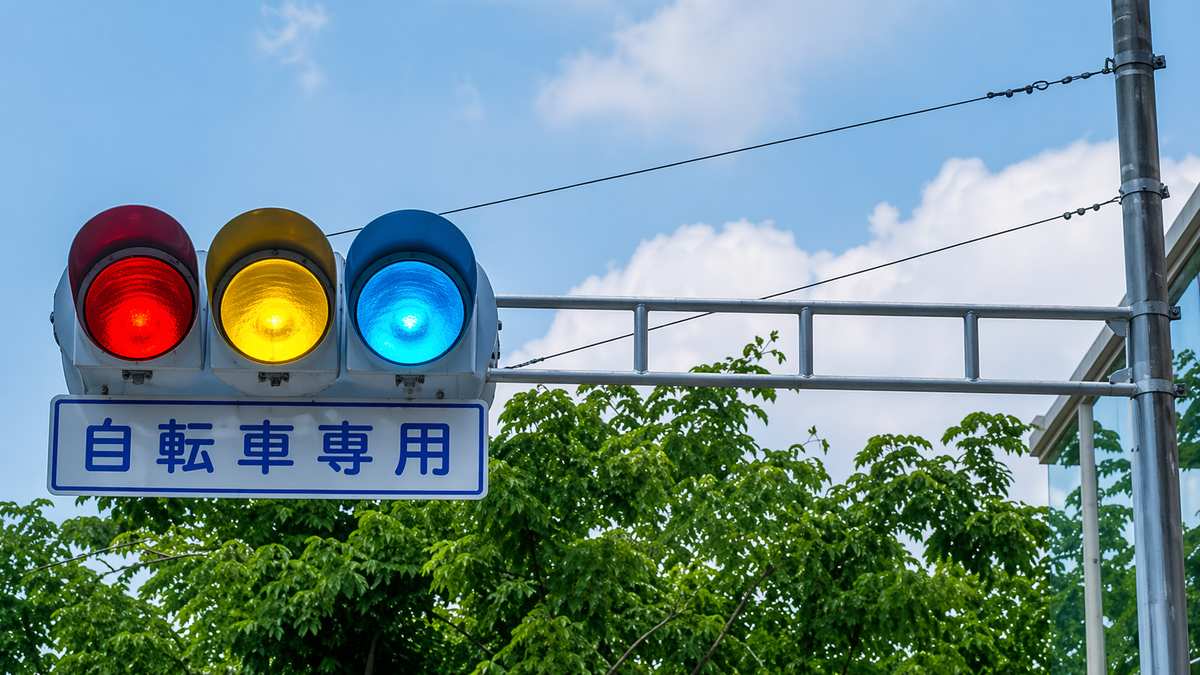
If you ever visit Japan and stand at a pedestrian crossing, you may notice something unusual, because the “go” signal on traffic lights can appear slightly blue instead of the bright green seen in most parts of the world. At first glance, this might seem like a simple design choice or a technological difference, but the reason behind this is much deeper and more interesting. Japan’s so-called “blue” traffic lights are not truly blue in the scientific sense, and instead, they reflect a unique combination of language, history, and cultural perception, showing how even everyday objects like traffic signals can reveal important aspects of a society’s traditions and way of thinking.
Also Read: 10 Driving Rules Other Countries Have, But the US Doesn’t
Language and the Meaning of Colour
The main reason why Japan calls green traffic lights “blue” comes from the Japanese language, because in the past, there was no clear distinction between the colours blue and green, and both were described using a single word, ‘ao’ (青). Because of this, many things that are green were traditionally referred to as blue, so green leaves, vegetables, and even unripe fruits were described using the word ‘ao’, and this linguistic habit has continued into modern times. Even today, green apples are called ‘aoringo’, which literally means “blue apples,” and traffic lights are referred to as ‘ao shingo’, meaning “blue signal,” which clearly shows that language plays a powerful role in shaping how people identify and describe colours.
The History of Traffic Lights in Japan
Traffic lights were introduced in Japan in the 1930s, following the international standard of red, yellow, and green, but because of the existing language tradition, the green light continued to be called “ao,” or blue. Later, in 1968, the Vienna Convention on Road Signs and Signals encouraged countries to standardise traffic systems, and although Japan is not strictly required to follow this convention, it still adopted the global standards for consistency. This created a unique challenge because Japan needed to follow the international rule of using green traffic lights while also maintaining its linguistic tradition of calling the signal “blue,” so the solution was simple but clever, as Japan chose to use the bluest possible shade of green for its traffic lights, which means the lights are technically green but may appear slightly blue to the human eye.
Cultural Views on Colour
The story of Japan’s traffic lights is not just about language or rules, but also about how people in Japan traditionally viewed colours, since in earlier times colours were grouped into a smaller number of categories, such as black, white, red, and blue. Over time, a separate word for green, ‘midori’, came into use, but language habits do not change quickly, so many people still use older terms in everyday speech, especially in familiar expressions. This shows that colour perception is not only based on science or light wavelengths, but is also influenced by culture and tradition, and what one culture clearly identifies as green might be described as blue in another.
Also Read: 20 Strange Travel Laws to Know Before Flying Abroad
Are Japan’s Traffic Lights Really Blue?
The simple answer is no, because scientifically Japan’s traffic lights are green, just like those used in the rest of the world, but they do have a slightly blue-green appearance and are still called “blue” in everyday language. This means they can be understood in three different ways, because scientifically they are green, visually they appear slightly blue-green, and linguistically they are called blue, which highlights how language, perception, and science can all describe the same thing in different ways.
Why This Matters
Japan’s “blue” traffic lights are a fascinating example of how tradition and modern standards can exist together, because while the country follows global traffic rules, it also preserves its linguistic and cultural identity. This small detail reminds us that even ordinary things like traffic signals carry deeper meanings, and it shows that the way we see and describe the world is shaped not only by science but also by language, history, and culture, so in a world that often focuses on uniformity and standardisation, Japan’s traffic lights stand out as a subtle but meaningful example of how diversity in perception can still exist.