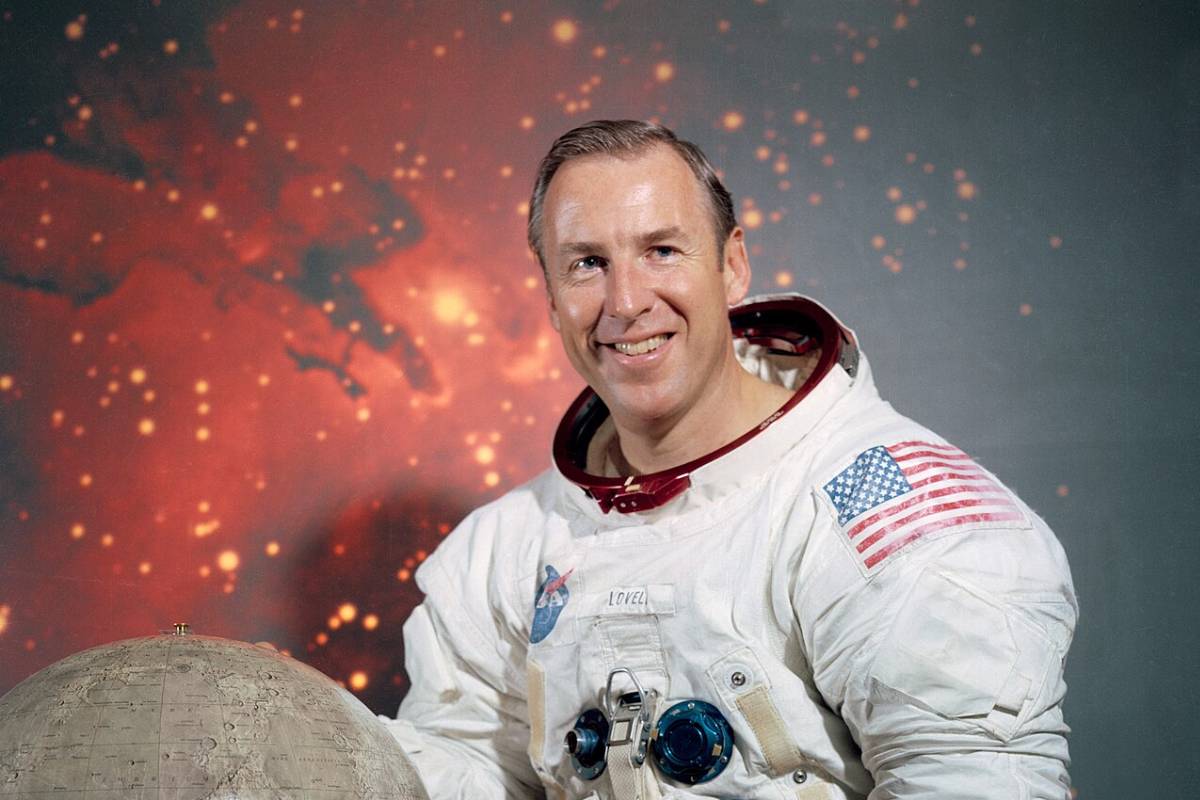
The excitement around Artemis II has brought up the stories of early space explorers again. As NASA gets ready for a new era of crewed deep-space travel, it is impossible not to compare it to missions from the Apollo era. Apollo 13 is the most famous of these missions, not because it landed on the Moon, but because it survived against all odds.
When talking about Apollo 13, you can not ignore the calm and decisive commander, Jim Lovell, whose leadership turned a near-disaster into one of the most famous rescue missions in space history. Lovell's journey from naval aviator and test pilot to NASA astronaut reflects a story of courage, resilience, and discipline that defined the early years of human space exploration.
Also read || SpaceX Starship V3: Why the May 2026 Delay is a Win
Life of Jim Lovell

James Arthur Lovell Jr. was born on March 25, 1928, in Cleveland, Ohio, to a family of a furnace salesman named James Arthur Lovell Sr. from Toronto, Canada. His father died when he was merely a kid, and his mother, Blanche Lovell, raised him as a single mother. Growing up, he was an exceptional student and studied at the University of Wisconsin before enrolling in the United States Naval Academy, where he graduated in 1952.
Jim Lovell’s academic drive and pilot expertise led him to NASA’s 1962 "New Nine" astronaut class. On Gemini 7 in 1965, he completed a 14-day endurance mission, proving humans could survive long-term in orbit. Later, he commanded Gemini 12. His transition from naval test pilot to astronaut was fueled by technical mastery, making him a natural fit for the complex challenges of deep-space exploration and the path to the Moon.
On Apollo 8 in 1968, James Lovell Jr. became one of the first humans to orbit the Moon, helping NASA demonstrate that a lunar mission could be flown and brought home safely. Then came Apollo 13 in 1970, the mission that defined his public legacy. Apollo 13 was planned as a moon landing, but an oxygen tank explosion turned off the spacecraft mid-flight.
The focus of the mission shifted from landing to entirely on survival. The crew relied on the Lunar Module as a lifeboat and on Mission Control's intense calculations to return home. Although the mission did not achieve its original goal, it is still considered a "successful failure" as they succeeded in returning safely, and improved NASA's deep-space procedures.
Also read || Artemis II: Humans Return to the Moon After 53 Years
Contributions of Lovell

Jim Lovell flew four crucial space missions, which were Gemini 7, Gemini 12, Apollo 8, and Apollo 13. During the formative years of human spaceflight, Lovell became one of NASA's most experienced astronauts. His technical expertise and missions helped develop long-duration living in space, orbital rendezvous, navigation, and the procedures needed for deep-space travel.
Lovell became a symbol of composure under pressure. His heroics at Apollo 13 showed how leadership, teamwork, and engineering can still save lives when everything goes wrong. The Apollo 13 lessons are still relevant for modern missions, including Artemis II, where safety, planning, and redundancy are central to NASA's approach.
Also read || SpaceX Boosts Starlink Network to New Records
Why is Jim Lovell trending
Artemis II has brought Apollo history back into the spotlight in a very direct way. NASA recently used a recorded message from Lovell to wake the Artemis II crew during the mission, which is why Jim Lovell is trending after eight months of his demise. It was an emotional moment that reminded people of Apollo 8, Apollo 13, and the human side of lunar exploration.
“Hello, Artemis II, this is Apollo astronaut Jim Lovell. Welcome to my old neighborhood,” Lovell recorded in a message before his death on August 7, 2025. The attention grew even more because Artemis II has surpassed the Apollo 13 record for the farthest distance humans have traveled from Earth. That milestone naturally revived public interest in Lovell, since Apollo 13 is the previous benchmark and one of the best-known survival stories in space history.
People are remembering Jim Lovell's story because it helps us understand the modern Moon program. Artemis II is not Apollo 13, but it is the same long journey back to the Moon. Lovell's name reminds us of the bravery, accuracy, and determination needed for missions like these.
Comments (0)
Log in to share your thoughts
No comments yet
Be the first to share your thoughts!