
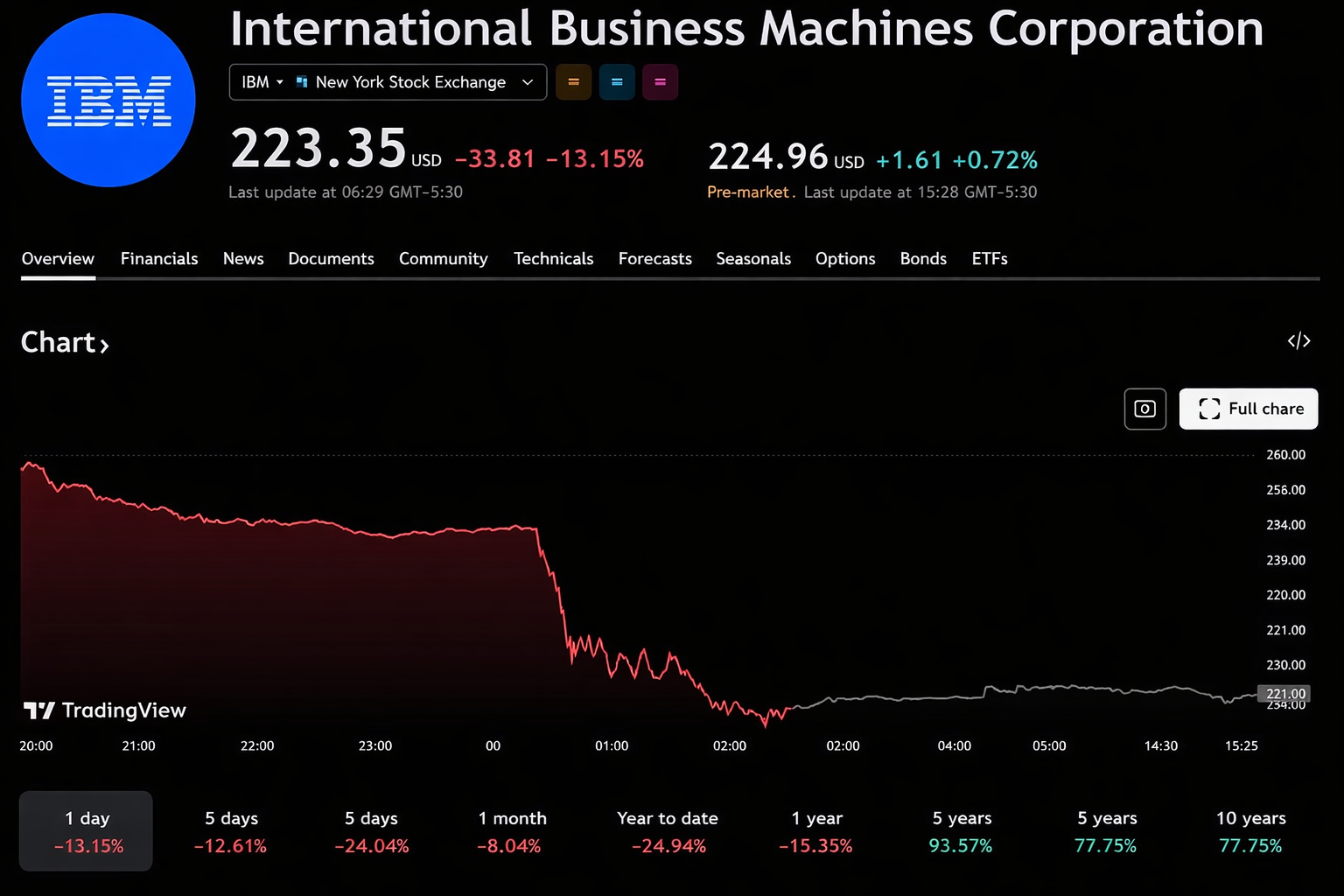
Shares of International Business Machines Corporation (IBM) fell sharply on February 23, 2026, after an artificial intelligence startup announced a new tool that could modernize legacy computer systems. The stock dropped about 13% in a single trading session, marking IBM’s steepest one-day decline in more than 25 years.
The sharp fall erased roughly $30 billion in market value and triggered wider concerns across the technology sector.
What Happened on February 23, 2026
On Monday, February 23, 2026, IBM shares declined between 13.1% and 13.2% during regular trading hours. It was the company’s worst single-day percentage drop since October 2000.
The stock closed around $222 to $223 per share, significantly lower than its recent trading levels. The sudden decline came after investors reacted to an announcement from AI startup Anthropic.
The AI Tool That Sparked the Sell-Off
On the same day, Anthropic revealed that its AI system, called Claude, can help modernize software written in COBOL, a programming language developed decades ago.
COBOL (Common Business-Oriented Language) is still widely used in banking systems, government databases, insurance platforms, and other large enterprise systems. IBM has long provided mainframe computers, software, and consulting services to support and upgrade COBOL-based systems.
Anthropic said its AI tool can analyze large COBOL codebases, map system dependencies, document processes, and help convert or modernize the code faster than traditional manual methods. Investors interpreted this as a possible threat to IBM’s consulting and modernization business.
Why Investors Reacted Strongly
IBM earns significant revenue from helping enterprises maintain and modernize legacy systems, especially those running on IBM mainframes. If AI tools can automate large parts of this work, demand for long and expensive consulting contracts could decrease.
Market analysts noted that investors are increasingly sensitive to announcements related to artificial intelligence. Even the possibility of disruption can lead to major stock price movements.
The drop also reflected broader concerns that AI could reduce the need for traditional software services across the industry.
Broader Market Impact
The sell-off was not limited to IBM. Shares of other consulting and enterprise technology companies also declined on February 23, 2026. Investors began reassessing companies that rely heavily on legacy system modernization.
The reaction highlighted growing anxiety in financial markets about how quickly AI tools are advancing and how they may reshape established business models.
IBM’s Position and Response
Following the market reaction, IBM emphasized that modernization of enterprise systems is complex and involves more than just rewriting code. The company stated that large-scale system transformation requires architecture planning, integration, security management, and regulatory compliance.
IBM has also been investing heavily in artificial intelligence. In recent years, it expanded its AI portfolio, including its Watsonx AI platform, and focused on hybrid cloud services.
The company maintained that AI tools can complement, rather than replace, enterprise consulting expertise.
Historical Context
IBM, founded in 1911, is one of the oldest and most established technology companies in the world. Over the past decade, it has shifted its strategy toward cloud computing, AI services, and enterprise consulting.
Before the February 23 decline, IBM’s stock had shown steady performance over the previous year. However, the sudden 13% drop marked one of the company’s most dramatic market setbacks in decades.
What Comes Next
Investors will closely watch IBM’s upcoming earnings reports and management commentary for further clarity. Analysts will examine whether the AI announcement leads to real changes in enterprise spending patterns or whether the market reaction was temporary.
The events of February 23, 2026, demonstrate how rapidly artificial intelligence developments can influence global financial markets. While the long-term impact on IBM remains uncertain, the stock’s historic decline reflects a new era in which AI innovation can quickly reshape investor confidence.