Researchers demonstrated a neuroscience experiment in which a digital model of a fruit fly brain was connected to a virtual body inside a computer simulation. The digital brain controlled the virtual insect and produced behaviors such as walking, grooming, and drinking in a simulated environment. The demonstration was carried out by the biotechnology company Eon Systems. One of the scientists involved in the project was Philip Shiu, who helped develop the computational model of the fruit fly brain. The aim of the research was to understand how brains process information and produces behavior.
The Tiny Brain That Inspired a Big Experiment
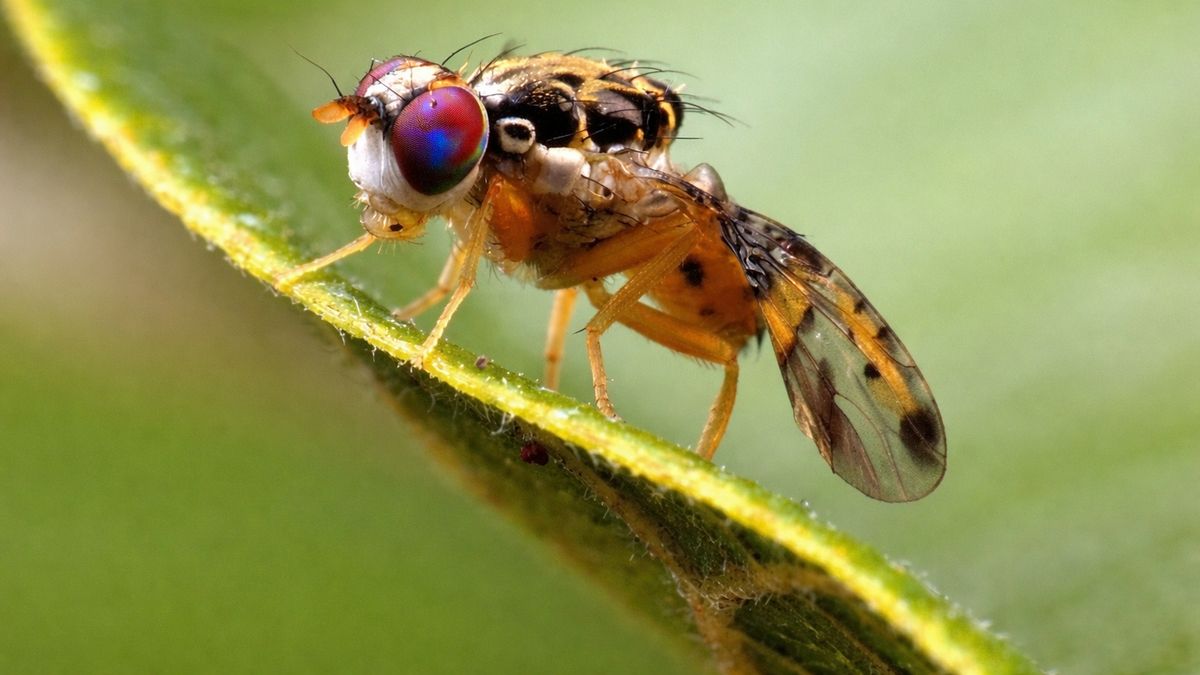
The organism used in the experiment is Drosophila melanogaster, commonly known as the fruit fly. Fruit flies have been used in scientific research for more than a hundred years because they are small, easy to study, and reproduce quickly. Even though they are tiny insects, fruit flies can perform many behaviors such as walking, flying, feeding, and grooming themselves. The brain of an adult fruit fly contains about 139,255 neurons, which are nerve cells that transmit signals in the nervous system. These neurons are connected by about 50 million synapses, which allow neurons to communicate with each other. Although the fruit fly brain is small, it is complex enough to control many behaviors. For comparison, the human brain contains about 86 billion neurons, making it far more complex than the fruit fly brain.
Also Read: Is AI Killing Your Creativity? MIT Study Reveals
Mapping the Brain: The Connectome Breakthrough
Before scientists could create a digital brain simulation, they first needed a complete map of the fruit fly brain. This map is called a connectome, which shows every neuron and every connection between neurons in the brain. On October 2, 2024, researchers announced the completion of the first full connectome of the adult fruit fly brain. This work was carried out through the FlyWire Project, an international research collaboration. Scientists from Princeton University, the University of Cambridge, and Google Research contributed to the project. One of the scientists involved in the research is neuroscientist Mala Murthy. To create the connectome, scientists used powerful electron microscopes to scan thousands of extremely thin slices of fruit fly brain tissue. Computers then reconstructed these images and traced every neuron and synaptic connection in three dimensions. The final connectome revealed about 139,255 neurons and more than 50 million synaptic connections, making it one of the most detailed brain maps ever created for an animal.
Turning the Brain into a Computer Simulation
After the connectome was completed, scientists used the data to build a computer simulation of the fruit fly brain. The simulation recreated the brain’s neural network by modeling neurons and their connections. Researchers also used machine-learning techniques to estimate neurotransmitters, which are chemical signals that neurons use to communicate with each other. Tests showed that the digital brain simulation could predict fruit fly motor behavior with about 95 percent accuracy, meaning that the neural activity in the simulation closely matched the behavior of real fruit flies. However, the digital brain alone could not produce visible behavior because it did not have a body.
Giving the Brain a Digital Body
To allow the digital brain to control behavior, scientists connected it to a virtual fruit fly body. The body simulation was based on the scientific model NeuroMechFly, which represents the anatomy and movement of a fruit fly. The model includes 87 movable joints, detailed three-dimensional anatomy, and realistic movement mechanics. The digital body was placed inside a simulated environment using the MuJoCo physics engine, which calculates forces such as gravity, motion, and collisions so that the virtual insect can move realistically.
The Moment of Truth: The Digital Fly Comes to Life
On March 9, 2026, scientists connected the digital brain to the simulated body and observed the results. The virtual fruit fly began to perform natural behaviors. It could walk around the environment, groom its legs, move its wings, and drink from a bowl placed in the simulation. These behaviors were not pre-programmed animations. Instead, they emerged naturally from the activity of the simulated neural network interacting with the virtual body and environment. This demonstrated that the neural wiring of the brain alone can produce behavior, even inside a computer simulation.
Why This Breakthrough Matters
This experiment allows scientists to study how signals travel through a complete brain and how those signals produce behavior. Researchers can also modify neuron connections in the digital brain and observe how behavior changes. This makes it possible to test scientific ideas about how brains work. Such simulations may help scientists study brain injuries, neurological diseases, and neural circuits. They may also help develop new brain-inspired artificial intelligence systems.
Also Read: The Speed of Now: How 2026 Is Defining The Era Of Ultrafast Fulfillment!
What Could Come Next?
Researchers hope to simulate larger brains in the future. One possible next step is the mouse brain, which contains about 70 million neurons, far more than the fruit fly brain. If scientists succeed in simulating larger brains, this technology could lead to new advances in neuroscience research, artificial intelligence, and our understanding of how brains work. The fruit fly experiment is an early step toward studying larger and more complex brains using computer simulations.
Comments (0)
Log in to share your thoughts
No comments yet
Be the first to share your thoughts!