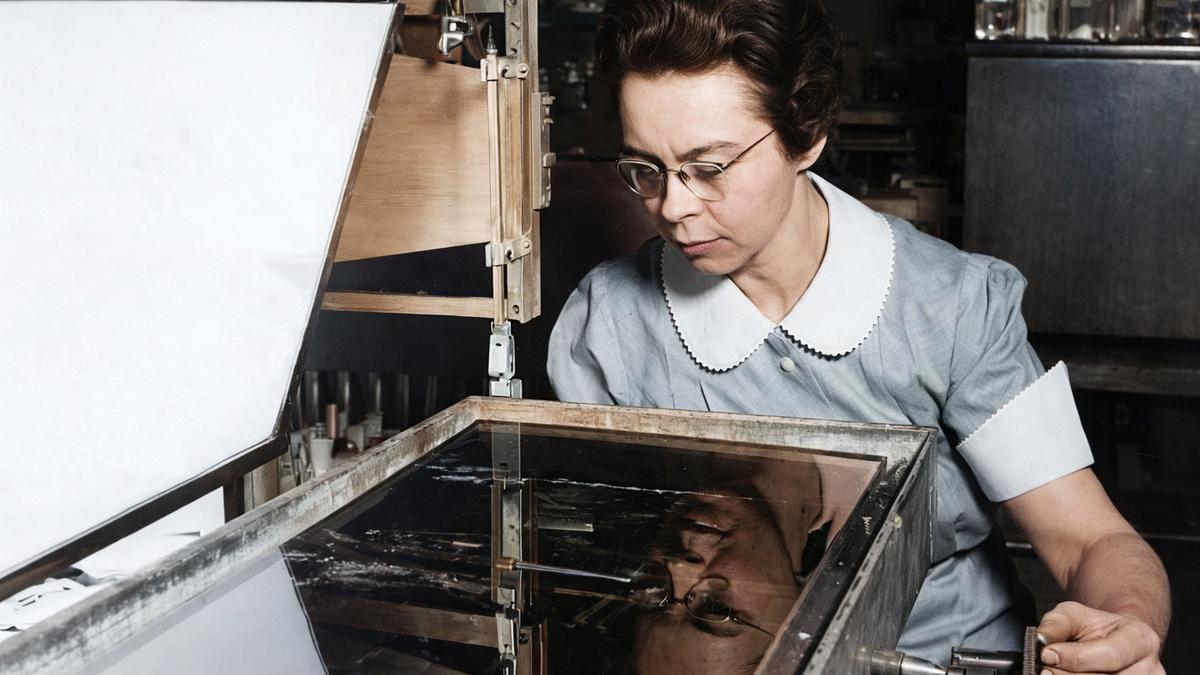
Katharine Burr Blodgett was an American physicist and chemist whose discovery helped cameras and many optical devices capture clearer images. She invented a special type of non-reflective or “invisible” glass that reduces glare and allows more light to pass through lenses. Because of her work, devices such as cameras, microscopes, telescopes, and eyeglasses can produce brighter and sharper images.
Early Life
Katharine Burr Blodgett was born on January 10, 1898, in Schenectady, New York, United States. Her father, George Reddington Blodgett, worked as a patent lawyer for the General Electric company, and her mother was Katharine Buchanan Burr. Before she was born, her father died after being shot during a robbery, leaving her mother to raise the family. During her childhood, Blodgett lived in both the United States and Europe, which gave her broad cultural and educational experiences. She later returned to the United States to continue her education and develop her growing interest in science.
Education
Blodgett showed strong talent in science and mathematics from a young age. She attended Bryn Mawr College in Pennsylvania, where she studied physics and graduated with a Bachelor’s degree in 1917. After completing her undergraduate studies, she continued her education at the University of Chicago, earning a Master’s degree in Physics in 1918. She later traveled to England to study at Newnham College, University of Cambridge. In 1926, she became the first woman to receive a PhD in physics from Cambridge University, an important milestone at a time when few women were working in scientific research.
Career at General Electric
In 1918, Blodgett began working at the General Electric Research Laboratory in Schenectady, New York. She became the first woman scientist hired by the laboratory, which was a major achievement at the time. At General Electric, she worked with the well-known scientist Irving Langmuir, who later won the Nobel Prize in Chemistry in 1932. Together they studied extremely thin layers of molecules known as thin films. These films are coatings that can be as thin as a single molecule. Their research helped scientists understand how these layers behave and how they could be applied to surfaces such as glass.
The Invention of Invisible Glass
Blodgett made her most important scientific discovery in 1938 when she invented non-reflective glass. Ordinary glass reflects a portion of light, which creates glare and reduces the clarity of images. Blodgett developed a method of coating glass with 44 extremely thin molecular layers. These layers canceled the reflections that normally occur on the surface of glass. As a result, the glass allowed more than 99 percent of light to pass through it, making the surface appear almost invisible. She received a United States patent in March 1938 for her invention, titled “Film Structure and Method of Preparation.”
Uses of Her Discovery
Blodgett’s anti-reflective glass quickly became useful in many technologies. It helped improve the quality of images in camera lenses, eyeglasses, microscopes, telescopes, and projectors. By reducing glare and increasing light transmission, the invention made optical instruments more effective. Today, similar anti-reflective coatings are also used in smartphone screens, computer displays, and many scientific devices.
Other Scientific Contributions
In addition to invisible glass, Blodgett made several other scientific contributions. She developed a device known as a color gauge, which measures the thickness of extremely thin films on glass by observing changes in color. During her career, she received eight United States patents and published more than thirty scientific papers. Her research also helped improve electric light bulbs, contributed to studies of electrical discharges in gases, and supported technologies such as aircraft de-icing and smokescreens used during World War II.
Awards and Recognition
Katharine Burr Blodgett received several honors for her scientific work. In 1945, she received an Achievement Award from the American Association of University Women. In 1951, she was awarded the Francis Garvan Medal from the American Chemical Society, which recognizes outstanding contributions by women chemists. In 1972, she received an Achievement Award from the Photographic Society of America. Later, in 2007, she was inducted into the National Inventors Hall of Fame in recognition of her important discoveries.
Death
Katharine Burr Blodgett passed away on October 12, 1979, in Schenectady, New York, at the age of 81.
Legacy
Katharine Burr Blodgett’s work changed the way glass and optical devices are used around the world. Her discovery of anti-reflective coatings allowed cameras and scientific instruments to capture clearer and brighter images. Today, her research continues to influence modern technology used in photography, electronics, and scientific equipment. She is remembered as a pioneering scientist whose discoveries helped people see the world more clearly.